Showing posts with label rome. Show all posts

Saturday, November 3, 2012

The travellers return

We're back. Actually, we've been back for two and a half weeks, but there's been plenty to keep me occupied and no time for blogging. I'm planning to share photos from the trip, but in the meantime here are some of the things we brought back.


I bought this necklace in Paris, from a little shop on Rue des Abbesses in Montmartre. We were stating up near the top of the hill, and walked past the shop many times during our two week stay, on the way to and from Abbesses metro station. The necklace was in the window, and caught my eye almost immediately - I bought on Day 2 of the trip, and later went back for matching earrings. The range of colours means it goes with just about everything :)

And this is how it looks on (with the earrings, and a new hair colour):

The next two photos are of one of my Venetian purchases. It was my birthday while we were in Venice, and I was given some money to buy something for myself (thanks everyone - you know who you are!). Nan McElroy, who I'd engaged to give us an introduction to Venice, suggested that I have a look at Attombri, next to the Rialto bridge. I did, and I met one of the two designers (brothers Stefano and Daniele Attombri - we met Stefano), who showed us some of their pieces. I couldn't choose between this one:


... and this one:


... so I came away with both :) The small glass beads in each one are from among thousands bought by the brothers when a Murano glass factory closed down - I was told they date from the 1920s. The larger beads are newer, and some are specially designed and made for Attombri, like the etched blue disk above.

And then to Rome, where we found Sancesario Bijoux on via dei Banchi Vecchi. Another artisan workshop, the family of designers only make a maximum of six copies of any one piece. The jewellery is all made by hand, using old techniques, and the glass in the earrings and bracelet I bought is Venetian.


Friday, August 10, 2012

Travel books - part 1

I'm a bit (well, more than a bit) of a sucker for books. And when I'm planning a trip, my focus is on books about the places I'll be visiting, because I like to know stuff before I get there.

I still have my Eyewitness Travel guides to Paris and Rome on hand from the 2010 trip, but I've added the Venice and the Veneto guide from the same series this time.


They're great guides for planning, but pretty heavy to cart around, especially if you're going to more than one city, as I realised last time while dragging my bag up flights of stairs from the London Underground and up to our second storey apartment. So I'm using them a lot for planning, but don't intend to take any of them with me. With that thought in mind, I also bought the Eyewitness Travel Pocket Map and Guide for each city - a very condensed version of the larger guides, with a foldout map in the back of each book. They're only 154 x 74mm in size, and less than 10mm thick, so very portable. The writing is pretty tiny though - not too bad in good light, but I'm not getting any younger, so I kept looking to see if there was anything better.


I also have the laminated StreetSmart Paris map and CityFlash/Hallwag International Rome map from the 2010 trip. They're both good clear maps, although not all the smaller streets are named. You can write on them with an erasable marker - handy for planning routes - and just wipe them clean when you're done. The Paris map includes a metro map - very handy. I'll probably take these with me.


Then I found the Everyman Mapguides. These small (124 x 74mm) books divide the city into sections, with a foldout map and information (what to see, where to eat, etc.) for each area. While not all the small streets are named, the maps are very legible, and the format means you're not trying to deal with large folding maps in the wind. These ones will  be going with me.


Yes, that is a New York edition tacked on the end. Not for me - my parents are going to the US while we're in Europe, and I thought this might be handy for the couple of days they have in NYC.

Wednesday, July 11, 2012

Mmmm ... coffee!

I was browsing through the website 'A Guide to Rome' a few days ago, and came across a page on Caffè Greco in Rome. The author mentions that there are three 200+ year old coffee shops in the world: Le Procope (Paris, 1686), Florian's (Venice, 1720) and Caffè Greco (Rome, 1760).

Le Procope, which is now a restaurant - we may need to try it (they even have a children's menu if the boychild isn't feeling adventurous).


Caffè Florian in Venice, which over the years has attracted such notables as Goethe, Ugo Foscolo, Charles Dickens, Marcel Proust, Grabriele D'Annunzio and Eleonora Duse, Rousseau, Stravinsky, Modigliani, Antonio Canova, and Casanova.


 Caffè Greco, via Condotti, Rome, has its own list of famous patrons, including Liszt, Strauss, Mark Twain, Hans Christian Andersen, Baudelaire, Mendelssohn, Stendhal and Wagner. 

As we'll be travelling to all three cities on this next trip, I feel a need to check them all out ...

Tuesday, July 3, 2012

Rome food tour (9 weeks & 1 day)

I've just booked the X-man & myself onto a Walks of Italy Rome Food Tour. We start off at the Campo dei Fiori market, and learn about and taste different foods, including meats and cheeses, bread, olive oil and balsamic vinegar, gelato or cannolo, and coffee - of course! And we get to make (and eat) our own pizza in a restaurant - the X-man is pretty keen on that idea :)


I'm working on more structure for this trip - some tours, guided or self-guided, some museum passes (so we can visit lots of places, without having to stay for hours in each one to get our money's worth), and a few day trips out of the city for contrast.

Wednesday, October 19, 2011

The Arch of Septimius Severus


There has clearly been some significant excavation work done in the Roman Forum since Piranesi made his drawings in the 18th century. This is the triumphal arch of Septimius Severus, born in 145AD and Roman Emperor from 193-211AD. On the left is the Column of Phocas, erected in 608AD (Byzantine Emperor Phocas gained the throne by murdering his predecessor in 602, and came to Rome some time later to hand over the Pantheon to the pope - the column may have commemorated that event, and it was the last great monument in the Forum. Phocas was himself murdered in 610AD). Somewhere between 5 to 8 metres of soil  depth has been excavated from this area.

The church on the right is Santi Luca e Martina - compare the height of the door relative to ground level in the two images! Originally commissioned in 625AD as S. Martina, the church was named for Martina, who was tortured and beheaded for refusing to give up her Christian faith under Emperor Alexander Severus (a great nephew of Septimius Severus) in about 228AD. The church was rededicated as S. Luca in S. Martina in 1588, and rebuilt in the 17th century.

Monday, October 17, 2011

Basilica of Maxentius


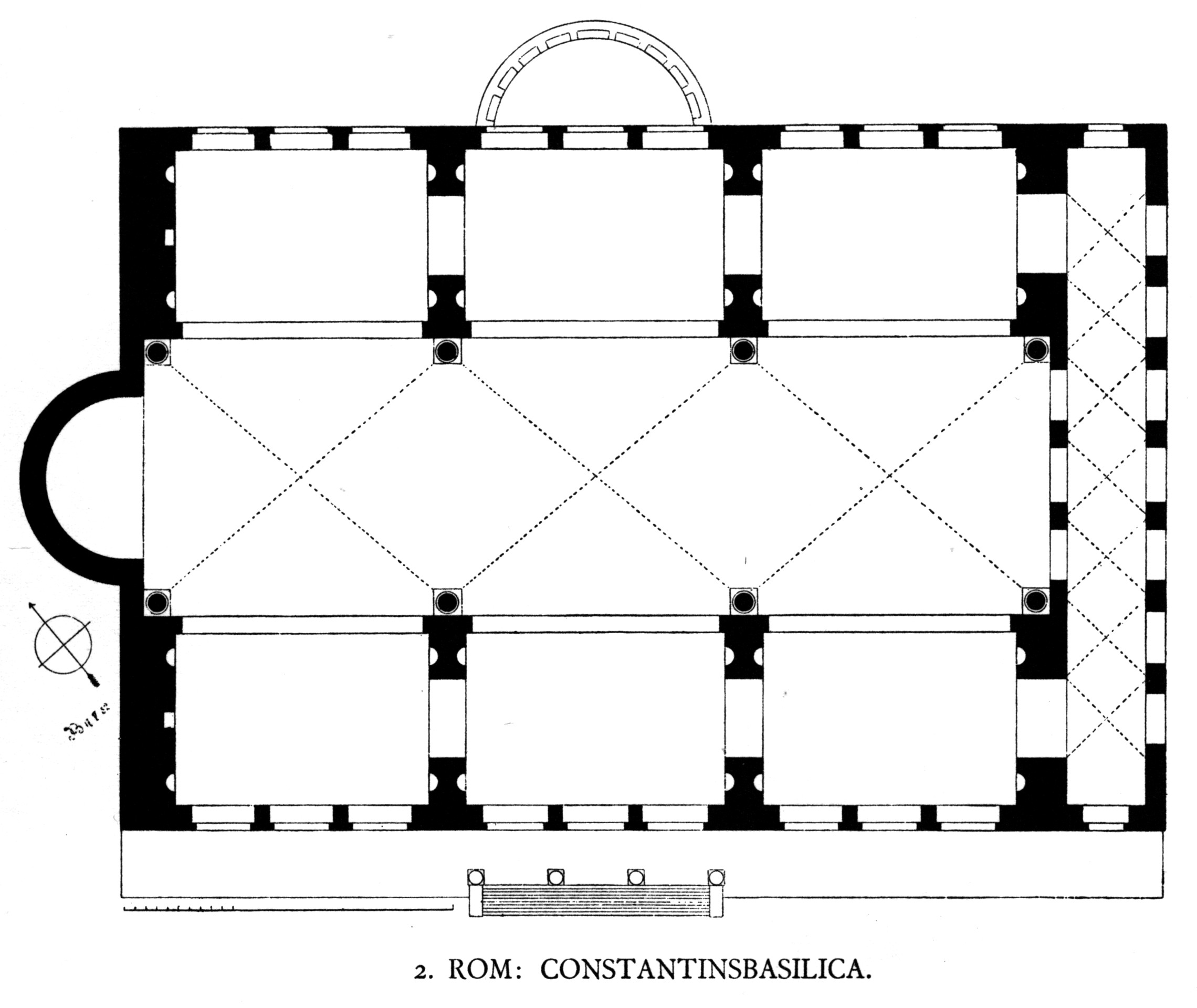
The Basilica of Maxentius - at the top, Piranesi's etching (1760), and my photograph (October 2010). These great vaults are just one side of the structure - there were similar vaults on the left, with a wide nave between them (as in the plan below). A basilica is more of a place for business and administration, rather than the religious function the word is generally associated with now.

A late 19th century plan of the Basilica (Wikimedia Commons)

The building is sometimes referred to as the Basilica of Constantine: Maxentius started construction, then was defeated by Constantine who completed the work, in the early 4th century AD. The side vaults are 20.5 metres wide and 24 metres high. The central nave was even higher - the roof above where I stood would have soared up to 35 metres high!

You've possibly seen the colossal statue of Constantine, the remains of which are now in the Capitoline Museums:


Apparently the statue sat in the semicircular apse on the left of the plan above, and started off looking like Maxentius. But Constantine had the features changed to look like himself once he'd taken over. No ego issues there!

Friday, October 14, 2011

Column of Marcus Aurelius

From Piranesi's Vedute, 1760
Piazza Colonna, October 2010

I love seeing how things change over time, and artworks of Rome produced over the centuries are amazing to compare with what is visible today. Giovanni Battista Piranesi's (1720-1778) etchings are of particular note. The two images above are clearly of the same column - the Column of Marcus Aurelius, in the Piazza Colonna. My photo is taken about 90 degrees clockwise from where Piranesi drew, but there's no mistaking it.

The column was completed by 193 AD, but the statue of St Paul was added as part of its restoration in 1589. There was probably a statue of the Emperor Marcus Aurelius originally, but that was lost well before the restoration.

Thursday, October 13, 2011

Things I missed the first time: St Peters


See all those people around the railing? They've climbed to the top of the dome of St Peter's, and have a fabulous view over Rome. We didn't do that. In fact, we got as far as St Peter's Square, and that was it. We didn't even go into the basilica, although before we left everyone said we should. In fact, there were quite a lot of things on other people's must-do lists that didn't get a look-in on this trip.


Oh, and we didn't go into the Vatican Museum either. One day I'll do that, but probably without a child in tow.

Monday, October 10, 2011

Things I missed the first time: Venus and Roma


It's massive, it's part of the Roman Forum, and it's right across from the Colosseum (from where I took this photo). It's the Temple of Venus and Roma, and we missed going in because it only opened to the public a week or so after we left Rome, following 26 years of restoration work. It was a double temple, dedicated the to the goddesses Venus Felix and Roma (the personification of the city of Rome). The statues of the two goddesses sat back to back in two cella - the space you can see here is the cella of Venus, who faced towards the Colosseum, while Roma faced the Forum.


From what I can gather, the top grassed level is how big the temple was, with a double row of columns all round. The columns further to the right (and there are more out of frame on the left, were a side portico, and part of the complex, but separate to the temple. You can see a man and truck on the right where the grass slopes down to the next level, which gives you some idea of the scale of the structure. Like I said - massive.

The statues of the goddesses, each seated in her cella, were apparently so large that they wouldn't have been able to stand up straight in the building if they chose to do so! In fact, a celebrated architect of the time, invited by the Emperor Hadrian (who designed the temple) to comment, said as much, and was banished and later executed for his honesty (apparently he and Hadrian had some history, and he wasn't impressed with other of Hadrian's designs - perhaps not a wise position when the person you are criticising has the power of life and death over you).

If it was all Hadrian's idea, he was a pretty clever bloke. Roma's relevance to the city is obvious - she is the city. But what is the significance of Venus? Well - Venus (known as Aphrodite by the Greeks), according to Greco-Roman mythology, was the mother of Aeneas (his father was the Trojan king Priam). After the fall of Troy, Aeneas and a small group of men made their way to Italy, where his descendants included Rhea Silvia, the mother of Romulus and Remus, the twins who were exposed to die, but who were rescued by a she-wolf and lived to found Rome. So Venus could be considered the mother of Rome.

Another clever aspect of housing these two goddesses together lies in their names: Venus is the Goddess of Love: amor in Latin. AMOR:ROMA, and they sit back to back :)

I'm hoping this area will still be open next time I'm in Rome - it would be amazing to stand in this grand space. And to think that until the 1980s the space was used as a carpark!

Saturday, October 8, 2011

Things I missed the first time: The Basilica of San Nicola in Carcere

As I read more about Rome, and look through the photos I took last year, I realise just how much I missed. To be expected, I guess, on what was my first big trip overseas on my own (yes, Miss Tizz was with me, but I was totally responsible for everything - the bookings, where we went, what we saw, the works). We did a lot of wandering, going from one incredible sight to the next, often without a particular plan, and obviously not taking in all the Eternal City has to offer. Actually, I think it would take many years to see it all, and even then I suspect Rome would continue to surprise me.


So ... I was reading a blog about Rome - Revealed Rome - and saw a photo of a familiar building. I remember clearly standing beside it and wondering what it was, and then shifting my gaze further to the right and being overwhelmed to realise that the Capitoline Hill was just across the road. And somehow I never did find out what this odd building with the columns built into the wall was. But now I know!

The columns in the photo above are from the Temple of the Goddess Hope - from 250 BC! But that's not all. On this site there are the remains of three ancient temples, with the much newer basilica built right into them!


This is the basilica from the front. You can just see the columns from the previous photo on the far left. The columns that are part of the lighter coloured facade are from the Temple of Juno, and on the right, next to the medievel belltower, are the remaining columns of the Temple of Janus. The three temples were constructed at various times in the second and third centuries BC. The site itself was a vegetable market before any of the temples were built (the Tiber River is just across the busy road behind the basilica), and there was a prison here (the in Carcere part of the basilica's name) in Byzantine times. The main building dates from about the 6th century AD (perhaps), although the first mention of the church in written history is apparently in the 11th century, and there have been numerous alterations since them.

All very fascinating, and you can also go down to the crypt to the old ground level, and see the podiums of the temples.

And that's not all I missed the first time: that odd-looking building to the right of the church in the second photo is part of the Theatre of Marcellus. Not that we missed it, but we normally approached it from a different angle, and at the time I took the photo I didn't realise what it was. I was used to seeing the arches and colonnades (you can just see them on the far right), and had no idea that apartments had been built into the ancient structure.

So much to see next time, armed with more information so I know what I'm looking at.